
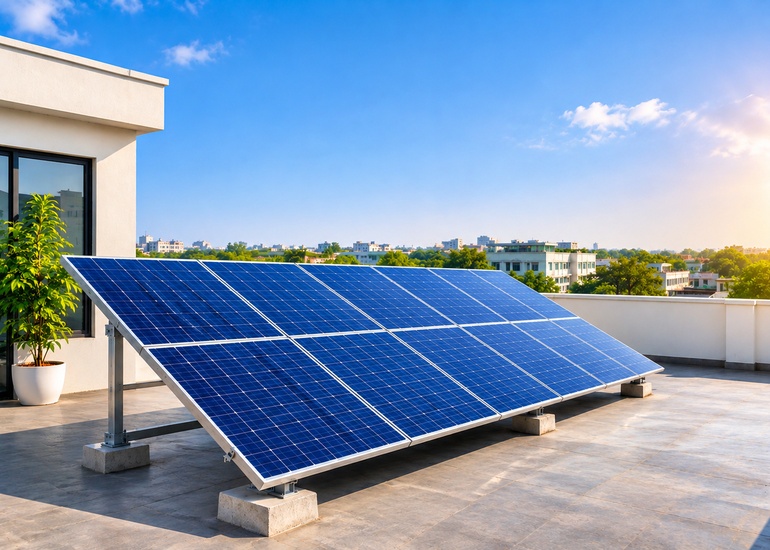
5 kW Solar Panel Price in Delhi with Subsidy: ROI Calculations Included
Installing rooftop solar is becoming a practical option for Delhi homeowners who want to reduce electricity bills and make better use of their roof space. However, before investing, most people want to know the actual 5 kW solar panel price in Delhi with subsidy, how much financial assistance they can receive, and how quickly the investment may pay off. Solar India helps customers explore solar solutions suited to their energy requirements and installation needs. A 5 kW on-grid solar system can be suitable for households with substantial electricity consumption, including those using air conditioners, refrigerators, washing machines, and other appliances. Understanding installation costs, government subsidies, electricity savings, and maintenance requirements can help you make an informed decision.
1. What Is the 5 kW Solar Panel Price in Delhi?
According to the Delhi government's solar calculator, installation costs are approximately ₹60,000 per kW for systems up to 5 kW. Based on this benchmark, a 5 kW rooftop solar system may cost around ₹3 lakh before subsidy. Actual quotations depend on equipment quality, roof conditions, and installation requirements.
| Cost component | Illustrative amount |
|---|---|
| 5 kW solar system with installation | ₹3,00,000 |
| Central government subsidy | ₹78,000 |
| Estimated cost after subsidy | ₹2,22,000 |
These figures are indicative, not a guaranteed quotation. Ask Solar India for an itemised estimate covering solar panels, inverter, mounting structure, wiring, installation, and applicable taxes.
2. How Much Subsidy Can You Get on a 5 kW Solar System?
Under the PM Surya Ghar: Muft Bijli Yojana, eligible residential consumers can receive central financial assistance of ₹30,000 per kW for the first 2 kW and ₹18,000 for the additional 1 kW. The total central subsidy is capped at ₹78,000 for systems of 3 kW or higher. A 5 kW system does not receive additional central subsidy for the capacity beyond 3 kW.
To apply, homeowners generally need to:
1. Register on the official PM Surya Ghar portal.
2. Submit the rooftop solar application and obtain the required technical feasibility approval.
3. Select an eligible registered vendor and complete installation.
4. Complete inspection, commissioning, and other applicable requirements.
5. Submit the required bank details to receive the approved subsidy.
Eligibility and documentation requirements should be checked on the official portal. Commercial and industrial consumers are not eligible for this residential central financial assistance.
3. Calculate Your Return on Investment (ROI)
The financial benefit of solar depends on how much electricity your system generates and how much of that electricity you use at home.
Consider this example for a 5 kW system:
| Calculation | Assumption |
|---|---|
| Monthly solar generation | 600 units |
| Annual generation | 7,200 units |
| Electricity used directly at home | 80% |
| Assumed electricity value | ₹7 per unit |
| Estimated annual savings | ₹40,320 |
| Net installation cost | ₹2,22,000 |
| Simple payback period | Approximately 5.5 years |
Calculation: 7,200 × 80% × ₹7 = ₹40,320 in annual savings.
The estimated payback period is ₹2,22,000 ÷ ₹40,320, or approximately 5.5 years. This is a simplified calculation that excludes financing costs, maintenance, degradation, tariff changes, and export credits. Actual savings may be higher or lower depending on household consumption and the applicable electricity billing arrangement.
4. What Affects Solar Panel Costs and Savings?
Several factors influence the final price and performance of a rooftop solar installation.
• Panel quality: Compare efficiency ratings, warranties, and manufacturer specifications.
• Inverter selection: Choose equipment compatible with your system and electricity requirements.
• Roof conditions: Shading, roof height, mounting arrangements, and available space can affect installation costs.
• Electricity consumption: Households that use more solar electricity during daylight hours may achieve greater savings.
• Net metering: Confirm applicable rules and compensation for electricity exported to the grid.
A 5 kW system also needs adequate, relatively shadow-free roof space. The Delhi Solar Portal estimates approximately 10 square metres per kW, although roof obstructions and mounting arrangements can change the usable area.
5. Why Consider Solar India for Your Solar Installation?
Choosing a solar provider involves more than comparing the lowest quotation. Solar India can help prospective customers explore solar products and understand the requirements of a rooftop installation.
Before finalising your purchase, ask about:
• Equipment specifications and product warranties.
• Installation scope and any additional charges.
• Expected energy generation based on your roof.
• After-sales service and maintenance arrangements.
• Assistance with applicable subsidy documentation.
A written quotation and realistic savings estimate make it easier to compare different proposals and plan your investment.
Conclusion
The 5 kW solar panel price in Delhi with subsidy can be estimated at around ₹2.22 lakh after applying the ₹78,000 central subsidy to an illustrative ₹3 lakh installation. Your actual cost and payback period will depend on the quotation, eligibility, electricity usage, and system performance. Solar India can help you explore suitable solar solutions and plan your installation based on your household's requirements.
Ready to explore rooftop solar? Contact Solar India to discuss your electricity consumption, available roof space, installation options, and an itemised quotation.
Frequently Asked Questions
1. What is the price of a 5 kW solar system in Delhi after subsidy?
Using an illustrative installed cost of ₹3 lakh and a central subsidy of ₹78,000, the estimated net cost is ₹2.22 lakh. The final amount depends on the selected equipment and installation conditions.
2. Is a 5 kW solar system eligible for government subsidy?
Eligible residential rooftop systems of 3 kW or higher can qualify for central assistance capped at ₹78,000 under PM Surya Ghar, subject to applicable scheme requirements.
3. How much electricity can a 5 kW solar system generate?
Generation varies with sunlight, shading, orientation, and system efficiency. For planning purposes, this article assumes 600 units monthly; actual output should be estimated for your specific roof.
4. How long does it take to recover the solar installation cost?
In the example above, simple payback is approximately 5.5 years. Your actual payback depends on installation cost, self-consumption, electricity tariffs, maintenance, and applicable export credits.
5. Can commercial properties receive the residential solar subsidy?
The central PM Surya Ghar subsidy discussed here is for eligible residential consumers. Commercial and industrial consumers should check the applicable schemes and DISCOM procedures before investing.