
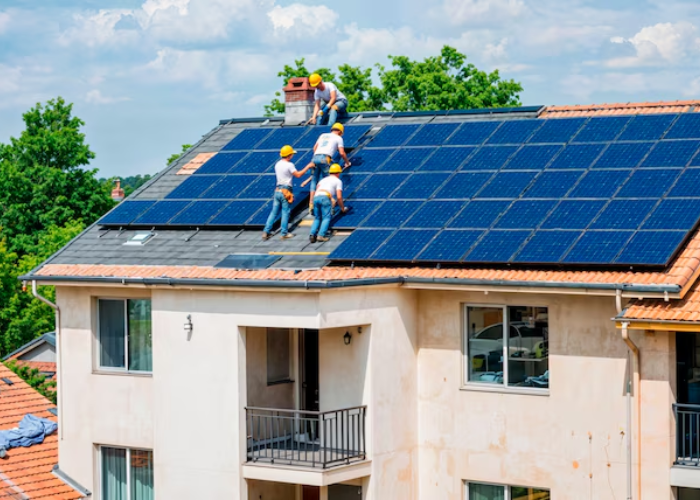
How Much Area Is Required for Solar Panel Installation at Home?
One effective measure to reduce electricity bills and transition to cleaner energy is installing solar panels at home. Nevertheless, the most frequently asked question among homeowners is: how much space is needed to install solar panels? This would be determined by your electricity consumption, the size of your roof, and the type of panels you use.
Knowledge of Your Power Requirement
To compute the space you have to be aware of the amount of electricity you use in your home. The average household in India is between 200 to 400 units per month. To produce this power, a solar system of 2 kW to 3 kW is usually demanded by most homes.
As a general rule:
1. A 1 kW solar system will need approximately 80-100 shadow free space.
2. A 2kW system would require about 160- 200 square feet.
3. A 240-300 square feet may be needed by a 3 kW system.
These figures may differ slightly according to panel efficiency and layout.
Normal Solar panel size and dimensions
Currently most residential panels have dimensions of 5.5 feet by 3.3 feet, and they are approximately 18 square feet per panel. The most common combination is 3 to 4 panels with 1 kW of power based on the power requirement.
High-efficiency panels available in the modern world have the ability to produce larger amounts of power using less space. Therefore, in cases where space on the roof is minimal, options of better quality modules can be taken to minimize the overall space required to install them.
Solar panel Requirements
There are a number of practical considerations which affect the calculation of the final space:
1. Roof Shape and Structure
Installation of flat roofs is not difficult since the roofing panels can be laid on the most conducive angle. The sloping roofs can reduce the available space through orientation or shade.
2. Shadow-Free Area
Shadows can be made by trees, adjacent structures and water tanks. The solar panels are only optimally produced with direct sunlight, meaning that it is only the shadow-free side of your roof that matters.
3. Panel Efficiency
Greater efficiency panels are also more efficient in terms of power output per square foot. Although they are more expensive, they are used when there is lack of space.
4. Structure and Spacing of Mounting.
The panels are not installed side-by-side. Installers provide airflow and access points during maintenance hence adding a small portion of volume requirement.
Is it possible to use Solar panels on small roofs?
Yes, but it has to be planned out. Houses that have a small roof area can have a smaller system such as 1 kW or 2 kW which can still contribute greatly to the savings on electricity bills. In other instances, other mounting systems like high buildings can be resorted to in order to maximize space.
Conclusion
Simply speaking, each 1 kW of solar power will require approximately 100 square feet of rooftop space. The specific space will depend on how much electric power you use every month, the size of the solar panels, the roof facing and the shading. When a solar power system is well-sited, it becomes efficient and safe in the long run.
In the case of homeowners who need professional advice regarding the best solutions to install on their roof, Solar India also offers technical assessment and installation services that may assist in the best system size ,depending on the available roof space and energy requirement.